How it works
Follow what is actually happening in gaming, not just what is loud today.
GamingDrift tracks movement across 32+ sources and turns it into an evidence-first view of what is gaining traction. It collects, compares, and ranks the topics that earn their place on the board.
Every feed you already use was built for a different job
What other sources give you
- Algorithmic feeds rank what gets clicks, shares, and time-on-site. Not what is building across independent sources.
- Editorial newsletters reflect one author’s view this week. One source, one opinion, no cross-source verification.
- Community votes surface what a specific audience found worth upvoting. Not sustained traction across the whole field.
- No baseline anywhere. When something appears in your feed, there is no way to know if it is a one-day spike or something that has been building for two weeks across a dozen publications.
GamingDrift
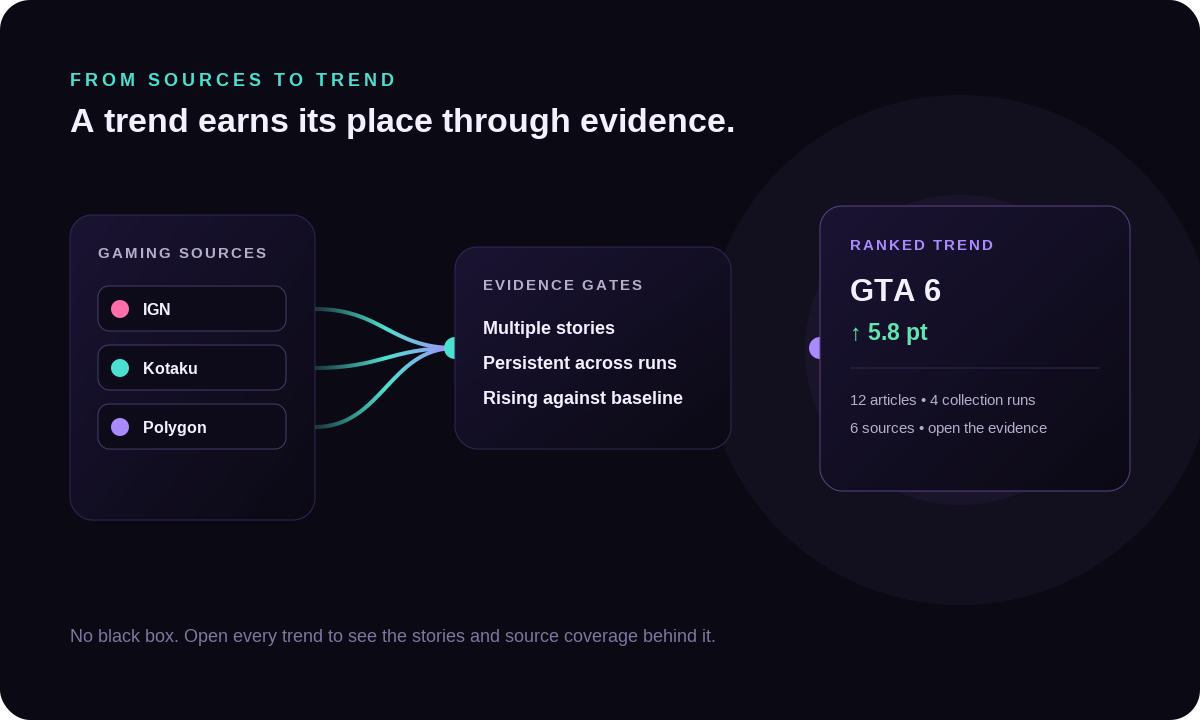
- Multi-source requirement. Topics must appear across at least 2 independent comparable sources. One loud outlet cannot manufacture a trend on its own.
- Persistence requirement. Coverage must hold across multiple collection windows. A one-day spike does not qualify, no matter how big.
- Baseline comparison. Momentum is measured against each topic’s own recent history, not against today’s total volume. What is loud today is not the same as what is building.
- Open evidence. Every topic shows the exact articles and outlets driving its score. Inspect the evidence before acting on it.
- 01
GamingDrift tracks the landscape
It monitors 32+ gaming publications and communities, building a shared evidence base instead of asking each person to curate a source list. The original publication and link stay attached to every story.
- 02
GamingDrift collects the evidence
New stories are collected on each source’s schedule and kept with their original publication, headline, excerpt, and link. The source material stays attached, so you can go straight to the reporting or discussion when something deserves attention.
- 03
Repeated topics build momentum
One loud article is not a trend. GamingDrift groups related stories and watches them over time for multiple distinct articles, persistence across collection runs, evidence from comparable sources, and measurable lift against the topic’s own recent baseline.
- 04
The board ranks what is rising
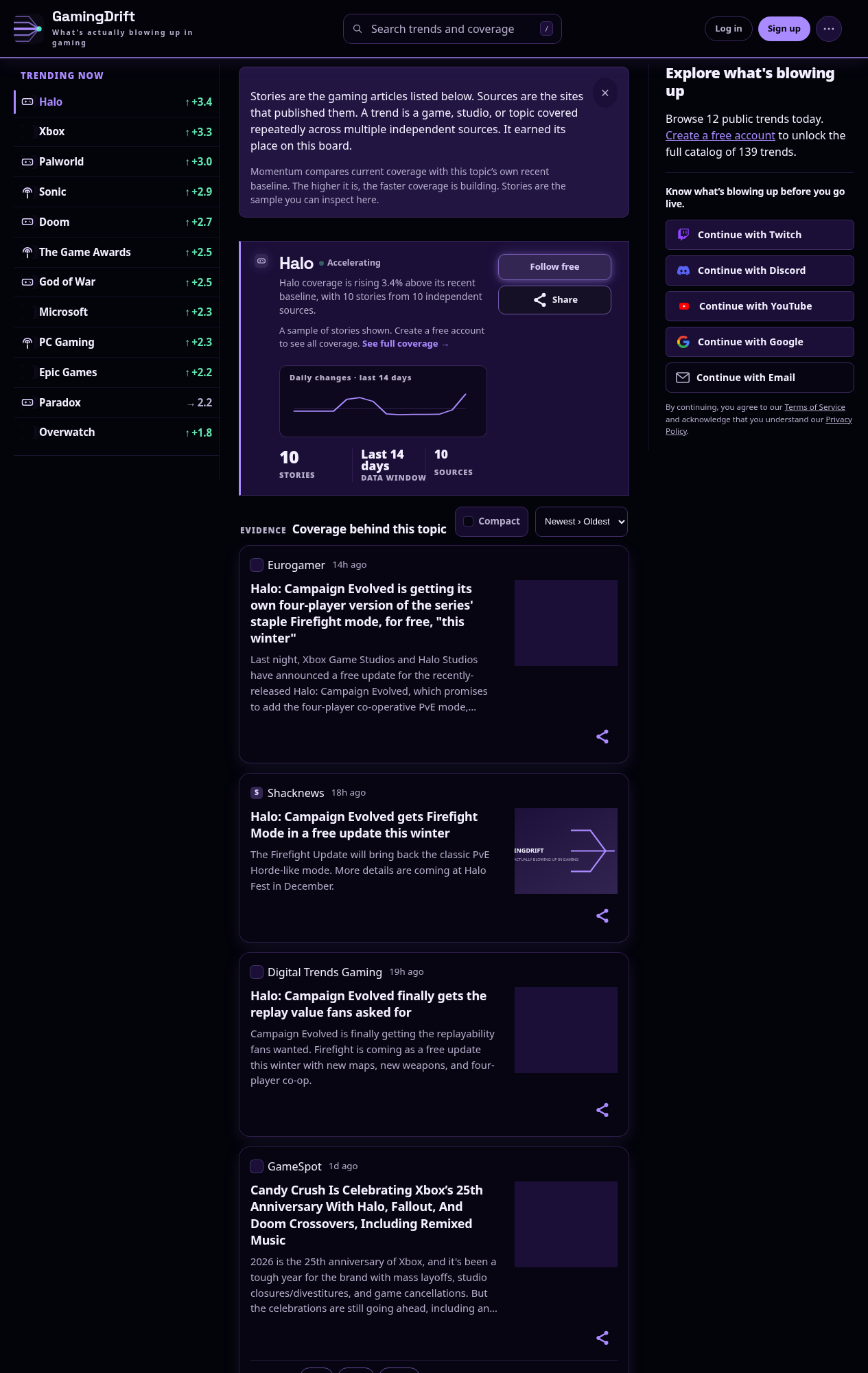
Topics that clear the bar appear on the board. Open one to inspect its lift versus baseline, article count, collection-run persistence, source coverage, and the actual stories behind it. Emerging topics that have not yet cleared the bar remain visible with the exact gate they missed, not disguised as finished topics.
Topics are scored on a momentum scale. Most active topics score between 2 and 7. High-momentum topics can exceed 10 in exceptional coverage bursts. No topic is penalised for not reaching any threshold.
- 05
Follow the topics worth keeping
Add a topic to your board for a focused view as new evidence arrives. Save articles for later, mark items as read, or ignore what is not useful. Your history and saved items stay with your account across the web and mobile experience.
- 06
Read deeply, then share the useful parts
Every topic opens into its supporting articles. Open the original source, keep your place, or share a topic or article with a teammate, friend, or group chat, complete with the context that explains why it belongs in the conversation.
- 07
Keep up without living in the feed
Use the board when you want the full picture, or let a digest bring meaningful changes back to you. Notification settings cover frequency, quiet hours, relevance, novelty, duplicate suppression, and digest size.
Trust the evidence, not a mysterious score
- Every topic traces back to its evidence. Open any topic to see the exact articles and outlets that drove its score. The evidence is always inspectable, never summarized away.
- Scores measure relative lift, not absolute volume. Momentum compares each topic against its own 14-day baseline. A niche topic spiking hard outranks a mainstream topic running steady. That is the correct behavior.
- Source diversity is enforced, not assumed. Topics must clear the bar across at least 2 independent comparable sources. A single high-volume feed cannot manufacture a trend on its own.
- Persistence is required. Coverage must hold across multiple collection windows. A one-day spike does not qualify, no matter how large.
- AI is advisory, not authoritative. When AI-assisted analysis appears, it is labelled with its confidence and uncertainty. It never silently overwrites deterministic scoring or source attribution.